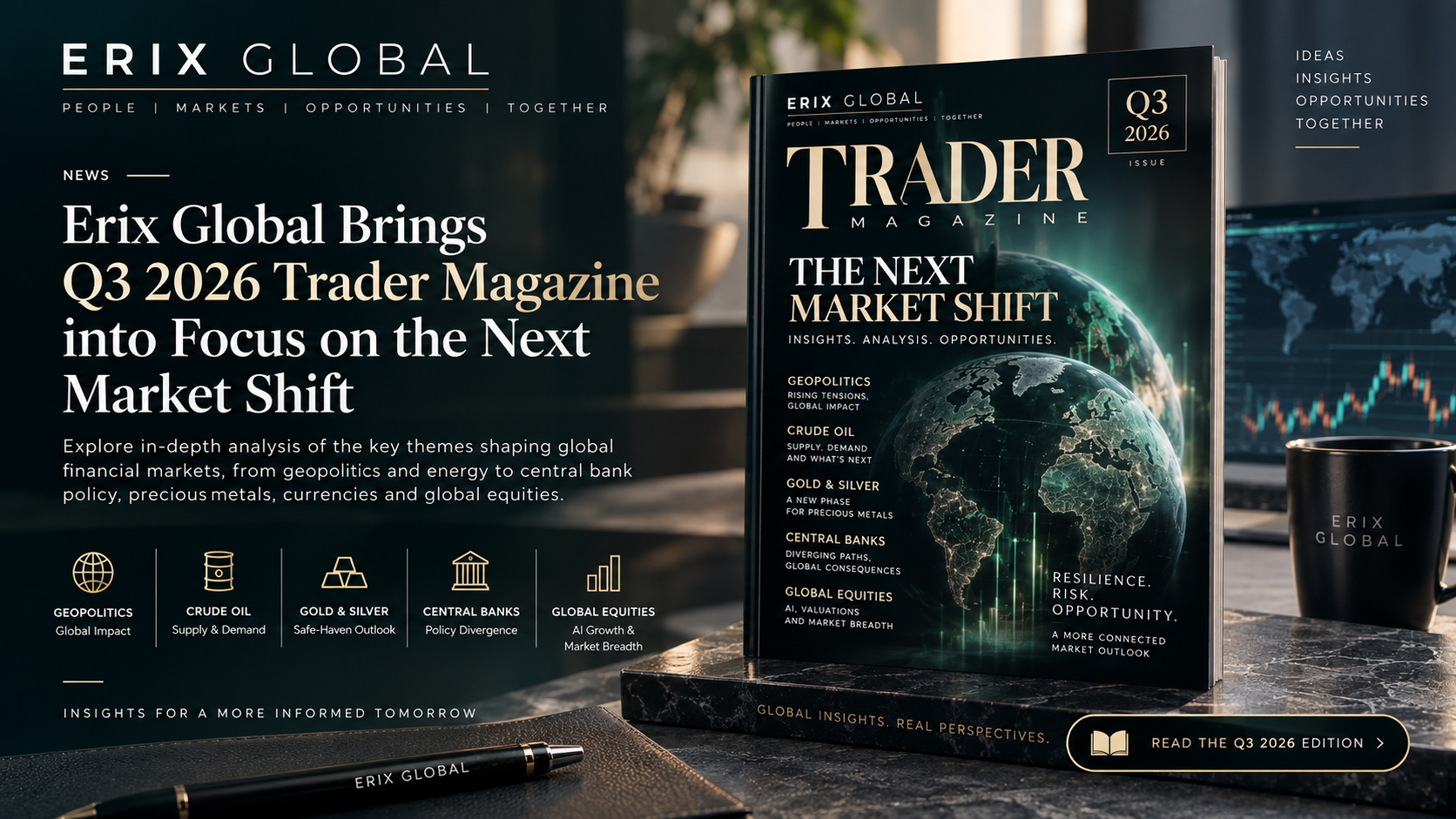

Erix Global Trader Magazine returns for Q3 2026 with a forward-looking examination of geopolitical risk, energy markets, precious metals, central bank policy and global equities as traders prepare for the next potential shift across financial markets.
Erix Global has released the Q3 2026 edition of Trader Magazine, bringing together market research, macroeconomic analysis and trading perspectives designed to help readers better understand the forces shaping global financial markets in the months ahead.
The new edition arrives at a time when investors and traders are navigating an increasingly complex environment.
Geopolitical developments continue to influence commodity markets. Expectations around monetary policy are evolving. Artificial intelligence remains an important theme within global equities, while questions surrounding valuations and market breadth continue to attract attention.
Against this backdrop, Erix Global Trader Magazine Q3 2026 focuses on one central question:
What Could Drive the Next Major Market Shift?
Rather than examining individual markets in isolation, the Q3 edition explores how geopolitics, inflation expectations, monetary policy, commodities, currencies and equities can interact to influence sentiment and capital flows.
The result is a connected perspective on a quarter where resilience and risk may increasingly exist side by side.
Navigating a More Selective Market Environment
Financial markets rarely move because of a single factor.
Oil prices can influence inflation expectations.
Inflation can affect expectations for interest rates.
Changes in monetary policy expectations can move currencies, bonds, equities and precious metals.
Meanwhile, geopolitical developments can rapidly alter assumptions across several markets simultaneously.
The Q3 edition of Trader Magazine examines these connections to give readers a broader framework for understanding changing market conditions.
Instead of attempting to provide certainty about future outcomes, the magazine considers different scenarios and the market forces traders may need to monitor as the quarter develops.
Five Major Themes Shaping Q3 2026
The latest edition concentrates on several interconnected themes expected to influence market behaviour throughout the quarter.
1. Middle East Developments and Global Market Volatility
Geopolitical developments in the Middle East remain an important consideration for global markets.
The Q3 edition examines how developments affecting regional stability and energy supply could influence oil prices, inflation expectations, investor sentiment and broader market volatility.
Energy markets can transmit geopolitical shocks into other asset classes.
Changes in oil prices, for example, can affect transportation and production costs, alter inflation expectations and potentially influence how markets interpret future central-bank policy.
Trader Magazine explores these relationships and the scenarios market participants may need to consider during Q3.
2. Crude Oil: Supply, Demand and the Quarter Ahead
Energy receives particular attention in the Q3 edition.
The magazine examines the crude oil outlook through several important variables, including inventory conditions, supply constraints, demand dynamics and geopolitical developments.
Rather than relying on a single directional assumption, the analysis considers different potential scenarios.
This scenario-based approach becomes particularly relevant when supply-side uncertainty and changing expectations for global economic activity can move energy markets in different directions.
For traders, understanding these underlying forces can provide useful context when interpreting price action.
3. Gold and Silver in a Changing Macro Environment
Precious metals form another major part of the Q3 outlook.
The magazine examines gold and silver against changing inflation expectations, interest-rate outlooks and geopolitical uncertainty.
Gold in particular can respond to multiple forces simultaneously, including movements in real yields, currency conditions and shifts in risk sentiment.
Silver introduces additional dynamics because its market can also be influenced by industrial demand.
The Q3 edition considers these factors together to explore how changing macroeconomic conditions could influence precious-metals sentiment during the quarter.
4. Diverging Central Banks and Currency Markets
Monetary policy remains one of the most influential forces in global financial markets.
However, major central banks do not necessarily move in the same direction or at the same speed.
Differences in inflation, employment, economic growth and domestic financial conditions can produce diverging policy expectations across economies.
These differences can have significant implications for currency markets.
The Q3 Trader Magazine examines how changing expectations around interest rates could influence major currencies and broader market sentiment.
For FX traders, the important question may increasingly be not simply whether global monetary conditions are tightening or easing—but which economies are moving first, how quickly they are moving and how expectations differ between them.
5. Global Equities and the AI Growth Story
Global equities enter Q3 with another complex set of considerations.
Artificial intelligence continues to influence investor expectations and corporate growth narratives in parts of the market.
At the same time, Trader Magazine examines questions around market breadth, valuations and the balance between bullish and bearish scenarios.
Strong performance concentrated within a relatively small number of companies or sectors can create a different market structure from a broad-based rally.
Understanding that distinction can become increasingly important when evaluating overall market resilience.
The Q3 edition therefore looks beyond headline index performance to examine some of the underlying dynamics influencing global equities.
Bull or Bear? Preparing for Both Scenarios
One of the defining ideas of the Q3 edition is that traders may need to remain flexible.
Markets can shift rapidly as new economic data, policy decisions or geopolitical developments challenge existing assumptions.
Martin Lam, Erix Global Chief Analyst for Asia Pacific, said:
“We expect that, at this critical juncture between bull and bear markets in Q3, we will require both analytical rigour and flexible strategic thinking.”
The statement captures the broader philosophy behind the latest Trader Magazine.
Market analysis is not simply about selecting a bullish or bearish narrative.
It is about understanding the variables that could support different outcomes and continuously reassessing those assumptions as new information emerges.
From Macroeconomic Analysis to Trading Perspective
The Q3 edition goes beyond high-level economic commentary by connecting macroeconomic developments with technical analysis and market structure.
This combination can provide readers with multiple perspectives.
Fundamental analysis can help explain why a market may be moving.
Technical analysis can provide additional context around how price behaviour is developing.
Market structure can help traders understand where trends, momentum and important price dynamics may be forming.
Bringing these approaches together provides a broader framework for evaluating market conditions.
Connecting the Markets
Perhaps the most important theme of Q3 Trader Magazine is that today’s financial markets are deeply interconnected.
Consider one possible chain of events:
Geopolitical developments → Energy supply concerns → Oil price movements → Changing inflation expectations → Shifting interest-rate expectations → Currency and bond-market reactions → Changes in equity sentiment.
The actual relationships are rarely this simple or predictable, but the example illustrates why analysing asset classes independently can leave important information out of the picture.
Erix Global Trader Magazine therefore approaches Q3 from a cross-market perspective.
Energy.
Precious metals.
Currencies.
Equities.
Monetary policy.
Geopolitics.
Each represents a separate market story—but together they can form a much larger picture.
Understanding the Next Market Shift
The central purpose of the Q3 edition is not to claim certainty about where markets will move next.
Financial markets remain inherently uncertain, and geopolitical and macroeconomic developments can change rapidly.
Instead, Trader Magazine focuses on identifying the factors that may matter.
Which developments could change inflation expectations?
Where could energy-market pressure emerge?
How might diverging central-bank policies affect currencies?
Can AI-related equity growth remain resilient?
Could market leadership broaden—or become even more concentrated?
How might precious metals respond if expectations around inflation, rates or geopolitical risk change?
These are the types of questions shaping the Q3 outlook.
Analysis for an Evolving Global Market
For traders, information is abundant.
The challenge is determining what matters, understanding how different developments are connected and evaluating how changing conditions could affect markets.
Erix Global Trader Magazine Q3 2026 is designed around that challenge.
By combining macroeconomic research, market analysis, technical perspectives and scenario-based thinking, the edition provides readers with a structured view of the quarter ahead.
As global markets move through another potentially important period, the message behind the Q3 edition is clear:
Observe the signals.
Understand the connections.
Challenge assumptions.
Prepare for multiple scenarios.
Because the next significant market shift may not begin in the market where traders first expect to see it.